
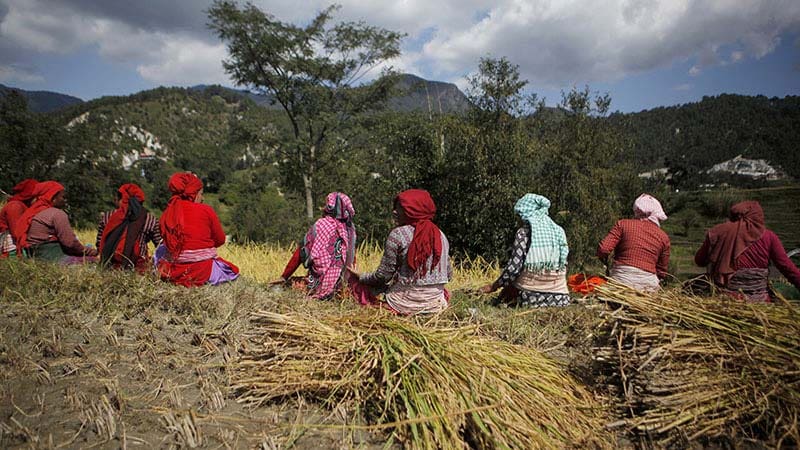
The UN declaration on the rights of Peasants and Other people working in rural areas (UNDRP) is towards its final approval and the moment of celebration of peasants is very near. The third committee (Social, Humanitarian and Cultural) of the UN General Assembly in New York on 19th November, 2018, voted in favour of the UN declaration on the rights of Peasants and Other people working in rural areas. The resolution was approved by 119 countries whereas seven countries stood against the resolution and 49 countries were absent during the processes. The declaration will be finally presented to the UN General Assembly coming December and peasants and other rural communities are eagerly waiting for the historical moment and a great victory in recognizing and ensuring their rights.
After the resolution has been approved, Bolivia, the nation chairing the process has said that it is a historical moment while the organizations fighting for this, La Via Campesina, FIAN International and CETIM shared that we are very near to the great victory.

United Nations has declarations and conventions to protect Human Rights (1948), Economic and Socio-cultural Rights (1966), Rights of Disabled Persons (1975), Indigenous People Rights (2007), Viena Declaration (1993), ILO 169, Refugee Rights (1951), Women Rights (CEDAW, 1979) and Children Rights (1989). Peasants of the world were in struggle last 17 years for this declaration and it was urgent to address the rights of small-scale producers, peasants and other people working in rural areas to protect from increasing neo-liberal attack. Very soon, they will also have a declaration protecting their rights.
Before it was presented to the UN General Assembly, the draft declaration was negotiated in the Human Right Council, intergovernmental working groups for the last five years for the fifth round of negotiation. Ultimately it was supported by the majority of the council members in September. Peasants around the world were eagerly waiting for the next step when the draft will be approved by the UN General Assembly after one month. It is expected that the declaration is the tool to ensure the justice to the peasants and other communities who feed the people and nations but go hungry and live in extreme poverty. The declaration will certainly overcome the situation of disrespect, distraction and marginalization of the peasant communities and wave path for the transformation of agriculture and rural livelihood.
The civilized and globalized world lives with the paradox that those food producers, peasants, landless, rural workers, herders, pastoralists and fisher folks representing 70% of all people who are under poverty and not having a dignified life as human beings. They are neglected, not respected and represented in mainstream politico-economic processes. Therefore, there was a very strong and consolidated voice from La Via Campesina (LVC), the global peasant network, envisioned and also act through the government of Indonesia to bring this discussion under United Nations (UN) processes. The homework started 17 years before in 2001 and in 2008 La Via Campesina, adopted the Declaration.
Two years later, the UN Human Rights Council instructed the 18 independent expert members of its Advisory Committee to propose ways and means to protect the rights of peasants and other people working in rural areas. The Advisory Committee presented its final study, including a draft declaration, in 2012 which was adopted by Human Rights Council in September 2012 and it created an open-ended intergovernmental working group to negotiate the UN Declaration on the rights of peasants and other people working in rural areas. Fisher folks, pastoral communities, indigenous people, migrant and seasonal workers, dairy workers, rural women and youth under La via Campesina along with International land coalition, FIAN international, CETIM, FIMARC, South Asian Feminist Alliance for Economic and Socio-cultural Rights etc. were the organizations continuously fighting for the declaration.
Out of 119 countries supported for the resolution, Bolivia, Cuba, Venezuela, Indonesia, China, South Africa, Nepal, Sri Lanka, Bangladesh, India, Afghanistan were the few one. The contribution of Bolivia has played a very leading role in this process since the very beginning whereas pro-people states like Cuba and Venezuela were continuously supporting it. US and UK including Hungary, Australia, New Zealand, Sweden rejected the declaration whereas 49 countries such as Brazil, Japan, France, Canada, Norway etc were absent during the process. The draft declaration with the right of peasants on food sovereignty, seed, land and other natural resources was not accepted by a few neo-liberal states including the UK, US and members of EU.
All Nepal Peasants Federation (ANPFa) has the central role to raise the issue of peasant rights in the international forum. Since long ANPFa had been advocating the peasant rights similar to trade union rights. ANPFa has succeeded to some extent in recognizing the contents of peasant rights as one of the pillars of achieving agrarian transformation and food sovereignty in the 20 years long agriculture development strategy (ADS, 2015-2035) and to some extent in the constitution of Nepal too. Now the struggle of the millions of peasants has been towards success to bring the declaration on rights of the peasants and other people working in rural areas in its final process.
The present draft declaration has 27 articles and two pages long preamble. It is the most strong part of the draft that along with the clear definition of peasants, the rights to food sovereignty, right to land, natural resources and biodiversity, right to seed and right to traditional knowledge and practices of peasants are protected, recognized and valued in the declaration. Though due to the anti-peasant claim of few states, still the document could not state clearly the demand of the peasants to ensure sustainable local agro-ecological practices and ban on GMO, pesticides and chemical farming as well as dismantle anti-peasants agreements and provisions of seeds, WTO provisions on AoA, FTA etc, it is really a progressive document to ensure rights of small food producers.
We know, Food is Life and without food sovereignty and rights to food, other rights of human dignity, freedom and justice are far to achieve. Therefore, it is important that the right of the producers who produce for the people and nations in a sustainable way of protecting biodiversity, respecting natural balance and conserving culture should be ensured. Ensuring rights of all small farmers and peasants who also represent the most marginalized class of the world is significant for those who are worried about the eradication of poverty, the future of the humanity and protection of mother Earth. Let’s act locally and think globally, taking globalization as a struggle and also a hope, to approve this declaration by the United Nations Assembly this December.