
By Pramesh Pokharel
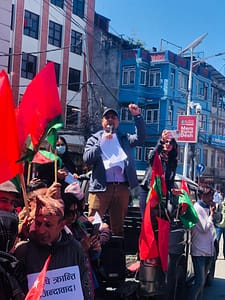
April 17 is a historic day for the peasant communities of the world. Similar to May Day for workers and March 8 for women, April 17 is the International Day of Solidarity and Action for Peasant Communities. Millions of peasants around the world have been celebrating this day as the International Day of Peasants’ Struggle for the last 29 years. In particular, the members of La Via Campesina, the largest peasant network of food producers in more than 80 countries observe this day with the call for Peasants’ Rights, Food Sovereignty, and an End to War and Genocide.
Since the 1996 massacre of peasants in Eldorado dos Carajás, in Brazil, where 21 peasants were murdered for fighting for agrarian reform, this day has symbolized solidarity, internationalism, and struggles for food sovereignty, peasant agroecology, agrarian reform, and peasant feminism, etc. Recently, the call has grown louder for the implementation of the United Nations Declaration on the Rights of Peasants and Other People Working in Rural Areas (UNDROP) and the fight for climate justice. This year, the struggle demands an end to the genocide in Gaza and an end to war and violence around the world. On this occasion, this article discusses UNDROP, its relevance, and its ratification process in Nepal.
What is the Peasants’ Rights Declaration (UNDROP)?
UNDROP is the acronym for the UN Declaration on the Rights of Peasants and Other People Working in Rural Areas. We know about various United Nations instruments to protect the rights of people and communities, such as the Universal Declaration of Human Rights (1948), the Covenant on Economic and Socio-Cultural Rights (1966), Rights of Disabled Persons (1975), Indigenous Peoples’ Rights (2007), the Vienna Declaration (1993), ILO 169, the Refugee Rights (1951), Women’s Rights (CEDAW, 1979), Children’s Rights (1989), etc. These international instruments have played an important role in protecting the rights of their respective groups, democratizing communities, and harmonizing national laws [1].
However, in the case of small food producers—who are primarily victims of systemic and structural crises—these UN standards have been insufficient. For many years, demands for a peasants charter were neglected and undermined. Peasants’ movements, led by La Via Campesina, advocated for the declaration for decades, negotiating with UN bodies. Though it did not result in a binding legal charter, the achievement came in the form of a declaration on December 17, 2018 [2].
This campaign, initiated by La Via Campesina 30 years ago, began its formal process 20 years ago and, after a long struggle at different levels, became a reality. Many may not realize that tDecember 17, 2023, marked five years since the declaration was adopted by the United Nations General Assembly [1].
Chronology of the Peasants Struggle for Peasants Rights Law in Nepal
All Nepal Peasants’s Federation (ANPFa) has long advocated for comprehensive legislation addressing peasants’ rights, which has been one of its core struggles. ANPFa actively participated in developing UNDROP from its initial discussions within La Via Campesina, including early initiatives led by Indonesia’s SPI.
The neoliberal policies implemented in Nepal after the 1990s exacerbated the challenges of low agricultural productivity. This era saw accelerated commercialization of agriculture, leading to resource privatization, widespread landlessness, and the marginalization of small-scale producers.
Even under democratic governments—including those led by leftist parties—meaningful land reform programs never materialized. Without structural challenges to production systems, farmers lost control over their means of production, fueling landlessness and absentee land ownership. This vacuum enabled the rise of a comprador class that exploits agricultural resources without investing in rural communities.
That is why beyond peasants’ movements, even NGOs and INGOs have advocated for farmers’ legislation, particularly regarding international organizations like the CBD, TRIPS, ITPGRFA, and WTO rules. A seminal 2008 study “Legal Mechanisms to Protect Farmers’ Rights in Nepal” by Kamalesh Adhikari (PRO PUBLIC/SAWTEE), urges legal protections [3].
The 2019 Kathmandu Declaration from the International Conference on Food Sovereignty and Peasants Rights emphasized: “We commit to fighting for peasants’ rights-ensuring those practicing small-scale farming can live with dignity and prosper. UNDROP and food sovereignty rights are essential tools to achieve this vision” [4].
Completing this, Nepal’s National Human Rights Commissions (NHRC) published “Reinforcing Peasants’ Rights”, which recommended constitutional recognition of peasants’ rights through Farmers’ Law [5]:
- The National Farmers Commission (2017/2018 AD) worked to define farmers identities and rights, identifying UNDROP-drived rights needing legal protection;
- ANPFa leaders like Pramesh Pokharel have consistently advocated for UNDROP ratification, making every December 17 (UNDROP adoption) and April 17 (peasants’ Day) with targeted campaigns;
- Despite ANPFa persistent efforts to pushed the NPC, MOALD to draft legislation, progress has stalled;
- The 2015-2035 Agricultural Development Strategy ultimately included peasants’ rights as a core pillar due to pressure from the National Peasants Coalition [6].
Why Nepal Needs a Peasants’ Rights Law?
- To Secure Land Tenure: To combat landlessness and prevent displacement through legal safeguards against land grabs.
- Food Sovereignty Implementation: To legally define peasantry, challenge neoliberal policies, and rectify historical injustices.
- Climate Resilience: To mandate government support for sustainable agriculture and disaster-adapted farming.
- International Commitments: To align with UNDROP and SDGs commitments, unlocking international support.
- Rural Stabilization: Reduce distress migration by protecting livelihoods, peasants’ rights and curbing uncontrolled urbanization.
Conclusion
UNDROP is an achievement of the global peasant struggle—but it is not enough. It must be ratified and implemented at the national level. Only pressure and struggle from peasant movements can force states to act. Peasant activists, organizations, cooperatives, and people’s movements have a critical responsibility ahead.
Immediate steps include:
- Translation of the declaration into local languages.
- Training of Trainers (ToT) to raise awareness.
- Formation of pro-peasant public policies.
- National and global lobbying—particularly within the IFAD, FAO, and UN Human Rights Commission.
In October 2023, during its 54th session, the UN Human Rights Council adopted Resolution 54/11, establishing a new working group to implement UNDROP. This five-member expert group was appointed on April 5, 2024, during the 55th session. The group is responsible for promoting UNDROP, identifying gaps, sharing practices, and supporting rural communities—including small-scale farmers, rural women, herders, artisanal fishers, and Indigenous Peoples—in realizing their rights [7].
Finally, let’s celebrate International Peasants’ Day with a renewed call for the protection of peasants’ rights!
References
[1] United Nations. (2018). United Nations Declaration on the Rights of Peasants and Other People Working in Rural Areas (UNDROP). A/RES/73/165.
[2] La Via Campesina. (2018, December 18). Historic victory! UN Declaration on the Rights of Peasants adopted at UN General Assembly. https://viacampesina.org
[3] Adhikari, K. (2008). Legal mechanisms to protect farmers’ rights in Nepal. PRO PUBLIC & SAWTEE.
[4] Kathmandu Declaration. (2019). International Conference on Food Sovereignty and Peasants Rights. Organized by National Peasants/Farmers Commission Nepal/Government of Nepal.
[5] National Human Rights Commission [NHRC]. (2019). Reinforcing peasants’ rights: Recommendations for implementation of UNDROP in Nepal.
[6] MOALD. (2015). Agricultural Development Strategy (2015–2035). Ministry of Agricultural and Livestock Development, Nepal.
[7] United Nations Human Rights Council [UNHRC]. (2024). Resolution 54/11: Implementation of the United Nations Declaration on the Rights of Peasants and Other People Working in Rural Areas. Geneva.
[8] Pokharel, P. (2020, April 17). International Day of Peasant Struggle: Peasant Rights and COVID-19. People’s Dispatch.
[9] Pokharel, P. (2021, October 28). All Nepal Peasants Federation Seek Assurance of People’s Right to Food Sovereignty. Fiscal Nepal.
[10] Pokharel, P. (2022, May). Peasants Rights Now!. Peasants Voice, All Nepal Peasant Federation (ANPFa) Bulletin.
[11] Pokharel, P. (2021, October 16). 25 Years of People’s Food Sovereignty. Ratopati.
[12] Pokharel, P. (2023, August). Food Sovereignty as a Constitutional Right in Nepal: Evolution and Challenges. La Via Campesina.