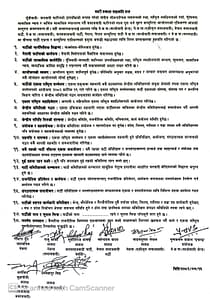
KATHMANDU – In a landmark move for Nepal’s political left, eight socialist and communist parties in Nepal have agreed to join forces under a unified banner, signalling fresh hope for progressive politics in the country.
On the weekend of Kārtik 19 (Nepali calendar),(On Nov 5, 2025) senior leaders from parties including the Communist Party of Nepal (Maoist Centre) (CPN Maoist Centre), Communist Party of Nepal (Unified Socialist) (CPN Unified Socialist), Nepal Socialist Party, Janata Samajwadi Party, and other progressive formations signed an 18-point consensus document to formalise a new party unification process. The election symbol chosen for the new entity will be the five-pointed star.
The accord was signed by veteran leaders such as Pushpa Kamal Dahal (“Prachanda”), Madhav Kumar Nepal, Mahendra Ray Yadav, Raju Karki, Suman Raj Kafle, and others, all pledging a new chapter of socialist unity in Nepal.
Key promises and plans
The parties declared the coming six months will be dedicated to organising a national congress to cement the unity and build the organisational structure from centre to ward level.
They resolved that the unified party’s guiding philosophy will be Marxism–Leninism and that the programme will emphasise a Nepali-specific “scientific socialism” rooted in the country’s revolutionary traditions.
The document commits to preserving republican democracy, safeguarding national sovereignty, promoting social justice, and pursuing economic and social transformation for the working class and marginalised communities.
The five-pointed star election symbol was selected to signify unity, hope, and the movement of all left forces under one banner.
Why this matters
For progressive activists, workers, youth and those committed to socialist values in Nepal, this political development brings new optimism. Nepal has long seen fragmentation among left-wing parties, diluting their influence. By combining forces, the left hopes to strengthen its capacity to advance policies on land reform, public ownership, social welfare, and the dignity of labour. In the words of one leader at the ceremony: “Now is the time to build a united front that can truly carry forward the mandate of the Nepalese people for social change.”
Looking ahead
The coming months will be crucial. The unified party will need to tackle internal coordination, build grassroots networks and substantially widen its base among youth, women, marginalised castes and ethnic groups. If successful, this could represent one of the most significant reorganisations of Nepal’s left in recent decades—and a stepping-stone toward renewed hope for socialist transformation in the Himalayas.
For international observers of left politics, the developments in Nepal underscore a broader trend: that left-wing forces are seeking to move beyond fragmentation and offer coherent alternatives to neoliberal and oligarchic models. If this new socialist alliance in Nepal sustains momentum, it may inspire similar movements in the region and beyond.