
Senior Chinese and US diplomats Wang Yi and Jake Sullivan concluded meetings lasting more than 12 hours on Friday and Saturday in Bangkok, Thailand, which were characterized as “candid, substantive and fruitful” strategic communication on implementing the consensus reached by the two heads of state at the San Francisco summit. Chinese experts believed that the latest talks signaled that both China and the US hope to stabilize bilateral relations through strategic dialogues, creating momentum for future progress, but the contention between the two countries over the Taiwan question is likely to persist, and potentially intensify.
Chinese Foreign Minister Wang, also director of the Office of the Central Commission for Foreign Affairs and a member of the Political Bureau of the Communist Party of China (CPC) Central Committee, stated that 2024 marks the 45th anniversary of the establishment of diplomatic relations between China and the US.
Both sides should take this opportunity to summarize experiences, learn lessons, treat each other as equals rather than jostling for a commanding position, seek common ground while reserving differences rather than emphasizing divisions, and genuinely respect rather than undermine each other’s core interests, Wang said.
Both sides should work together to promote mutual respect, peaceful coexistence, and win-win cooperation, and work toward the right way for China and the US to coexist, he noted.
The meetings, which spanned more than 12 hours over two days, wrapping up on Saturday, are intended to deliver on the agreement between the US President Joe Biden and Chinese President Xi Jinping at the San Francisco summit in November 2023 to restore ruptured diplomatic talks on a range of global security and economic issues like defense and counter-narcotics despite significant disagreements, Reuters said.
During the meeting, Wang stressed that the Taiwan question is a matter of China’s internal affairs, and the elections in the Taiwan region cannot change the basic fact that Taiwan is part of China. The biggest risk to peace and stability across the Taiwan Straits is “Taiwan independence,” and the biggest challenge to China-US relations is also “Taiwan independence,” the Chinese diplomat said.
In a readout issued by the White House on Saturday, Sullivan underscored the importance of maintaining peace and stability across the Taiwan Straits.
The latest talks had been planned since the end of last year, primarily as a continuation of high-level US-China interactions following the San Francisco summit between the heads of state, maintaining the consensus reached there, Wu Xinbo, director of the Center for American Studies at Fudan University, told the Global Times on Sunday.
“It also aimed at strategic-level communication on new developments in the situation, especially regarding the Taiwan Straits following the regional elections in the island,” Wu said.
Taiwan in focus
The defense authority on the island of Taiwan said on Saturday it detected 11 military planes from the Chinese mainland crossing the “median line” in the past 24 hours. The day before, the authority reported 23 air force planes from the mainland operating around Taiwan, carrying out “combat readiness patrols” with Chinese warships, according to Reuters.
A number of US media outlets including Voice of America said the readout from the Chinese Foreign Ministry emphasized its major concerns about the Taiwan question while in contrast, the White House only briefly mentioned the importance of “maintaining peace and stability across the Taiwan Straits,” and such different expressions might indicate a lack of consensus on the question between the two sides.
Diao Daming, professor at the School of International Studies at Renmin University of China, said he believes there is an area of consensus on Taiwan question between the two sides.
China’s stance is consistent, emphasizing the “two biggest risks,” meaning that “Taiwan independence” is detrimental to both China and the US, and at least the US does not support “Taiwanese independence,” which can be seen as a directional consensus, Diao told the Global Times on Sunday.
“I believe this should contribute to further stabilizing the situation in the Taiwan Straits and controlling and containing ‘pro-independence’ forces in Taiwan,” he said.
Following the regional election in Taiwan, the Biden administration extended its congratulations to DPP’s Lai Ching-te, toward which China expressed its firm opposition. A bipartisan delegation from the US Congress recently reaffirmed support for Taiwan during a visit to the island following the regional elections.
It’s evident that the Taiwan question will remain a focal point of US-China contention, Wu said, noting that China’s determination against “Taiwan independence” will continue with firm and forceful measures.
“While the US verbally supports the one-China policy and opposes ‘Taiwan independence,’ it still plays the “Taiwan card” in action, saying one thing and doing another. Thus, the US-China contention over Taiwan question is likely to persist and potentially intensify,” he said.
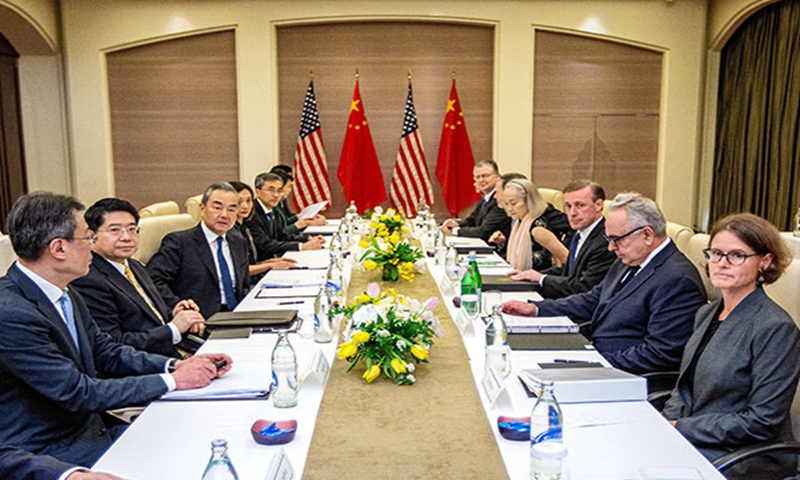
Senior Chinese and US diplomats Wang Yi and Jake Sullivan concluded meetings lasting more than 12 hours on Friday and Saturday in Bangkok, Thailand. Photo: Chinese Foreign Ministry
Momentum for future progress
Last May and September, Wang and Sullivan held meetings respectively in Vienna, Austria, and Malta. Some experts believed that both Austria and Malta are neutral countries in Europe. Although Thailand is not a neutral country as defined by international conventions, as the second-largest economy in Southeast Asia, it maintains healthy and stable relations with both China and the US.
The choice of Thailand as the venue for their meeting sends an important signal that China and the US have many issues to discuss regarding Asia-Pacific affairs and even global matters, experts said.
Both sides also discussed international and regional issues such as the Middle East, Ukraine, the Korean Peninsula, and South China Sea, according to the Chinese Foreign Ministry.
However, some US commentators, citing unnamed US senior official, reported that Sullivan used this occasion to press China to use its influence with Iran to ease tensions in the Middle East, emphasizing on the destabilizing effect of the Houthi attacks on international commerce.
Regardless of the regions, whether it’s as far as the Red Sea or close as the South China Sea, East China Sea, or even the Taiwan Straits, the stability and development of all these areas are beneficial to China and align with China’s strategic goals and interests. China will commit all its efforts to ensure stability in these regions within its capabilities, Lü Xiang, research fellow at the Chinese Academy of Social Sciences, told the Global Times on Sunday.
“Frankly, we don’t need the US to dictate our actions… the US spreading this speculation during the talks demonstrates a lack of sincerity and an overly calculating attitude,” Lü said.
During the meetings between Wang and Sullivan, the two sides agreed to continue exchanges at various levels and make good use of current strategic communication channels, as well as diplomatic, military, economic, financial, business, and climate change dialogues and consultations.
The US and China will also hold formal high-level talks in Beijing next week, and will also hold dialogue on AI risks in spring, according to media reports.
“The meetings also occurred in the final year of the current Biden administration, where the US foreign and security teams are trying to carve out a space for international activity,” Lü said, noting that the Wang-Sullivan meetings are positive for enhancing communication between the two countries, he remains reserved about achieving concrete outcomes in the specific agenda.
“The current US administration is in its final stretch, and we don’t have much faith in their ability to resolve actual issues. At this point, maintaining stability between China and the US already meets everyone’s expectations,” he said.