
In a landmark decision on April 4, 2025, South Korea’s Constitutional Court unanimously upheld the impeachment of President Yoon Suk Yeol, leading to his immediate removal from office. This ruling came after Yoon’s controversial declaration of martial law in December 2024, a move that was widely condemned as an authoritarian overreach and an attempt to suppress democratic processes.
Mass Celebrations Signal Public Endorsement
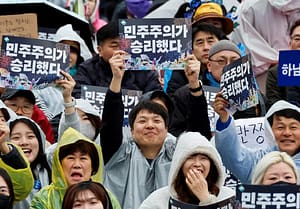
Following the court’s announcement, millions of South Koreans flooded the streets in nationwide celebrations, viewing the decision as a triumph over authoritarianism and a restoration of democratic order. Protesters brandished banners and chanted slogans advocating for democracy and peace, underscoring the public’s commitment to safeguarding their hard-earned freedoms.
Judiciary Condemns Yoon’s Constitutional Violations
Acting Chief Justice Moon Hyung-bae, delivering the court’s verdict, stated that Yoon’s imposition of martial law constituted a severe breach of constitutional duties and a betrayal of public trust. The court emphasized that such actions were unjustifiable and posed a significant threat to the nation’s democratic framework.
Background: The Martial Law Declaration and Its Aftermath
The crisis began on December 3, 2024, when President Yoon declared martial law following the National Assembly’s rejection of his government’s budget proposals. He justified the move by alleging the presence of “pro-North Korean anti-state forces” aiming to destabilize the nation. However, the declaration was met with swift and massive public opposition, leading to its retraction within hours. Subsequently, the National Assembly impeached Yoon on December 14, 2024, suspending his presidential powers and appointing Prime Minister Han Duck-soo as acting president.
Impeachment and Legal Proceedings
The impeachment motion passed with a significant majority, reflecting bipartisan consensus on the gravity of Yoon’s actions. Following his removal, Yoon faces criminal charges, including allegations of insurrection, with trial proceedings set to commence on April 14, 2025.
Implications for South Korean Politics and Regional Stability
Yoon’s tenure was marked by aggressive militaristic policies and a consolidation of alliances with the United States and Japan, escalating tensions in the Korean Peninsula. His removal opens the door for a potential shift towards more peaceful and diplomatic approaches in inter-Korean relations. The upcoming snap presidential election, scheduled for June 3, 2025, as mandated by the constitution, will be pivotal in determining the future direction of South Korea’s domestic and foreign policies.
Progressive Forces Advocate for Systemic Change
Leftist and progressive organizations, including the Korean Confederation of Trade Unions (KCTU) and the anti-imperialist group Nodutdol, have welcomed Yoon’s ousting as a victory for democratic forces. However, they caution that removing an individual leader is insufficient for achieving lasting change. These groups call for comprehensive societal transformation to address the underlying structures of oppression, particularly the capitalist system and foreign military presence, which they argue perpetuate inequality and hinder true democracy.
A Cautionary Tale for Nepal and Beyond
For Nepalese communists and leftist movements worldwide, South Korea’s experience serves as a poignant reminder of the perils of authoritarianism and the critical importance of vigilant public engagement in political processes. It underscores the necessity of building robust democratic institutions that can withstand attempts at power consolidation and highlights the role of grassroots movements in upholding democratic values.
Conclusion
The removal of President Yoon Suk Yeol marks a significant moment in South Korea’s democratic journey, reflecting the power of collective action against authoritarian tendencies. As the nation prepares for new leadership, there is an opportunity to pursue policies that prioritize peace, democracy, and social equity, resonating with the aspirations of progressive movements both domestically and internationally.