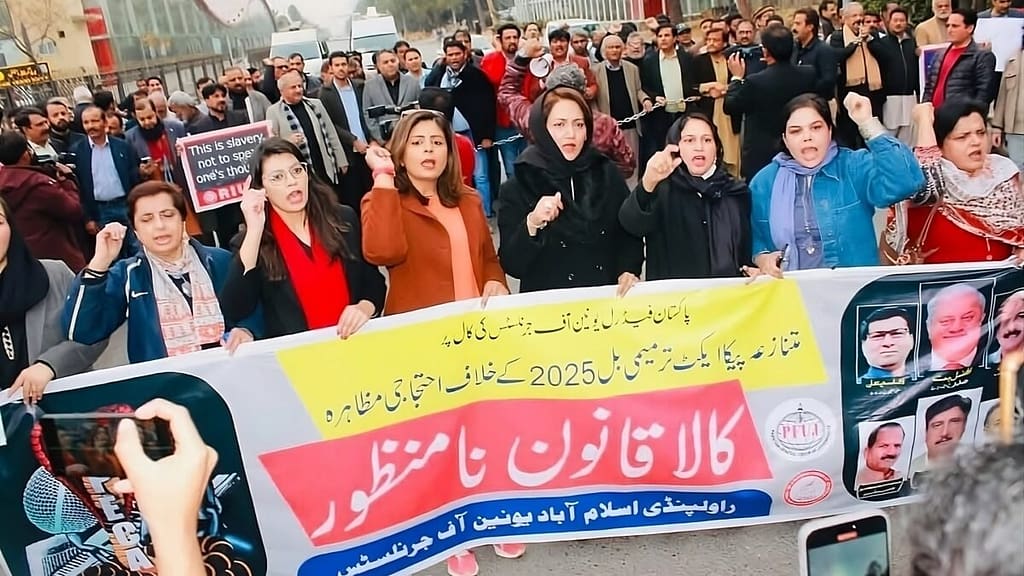
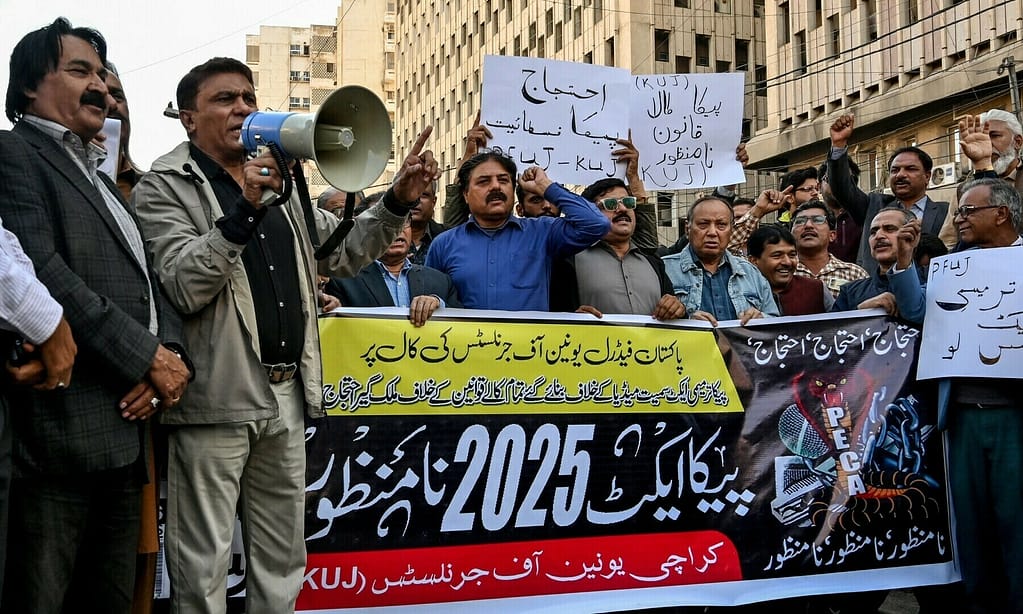
The growing chorus of alarm over Pakistan’s Prevention of Electronic Crimes (Amendment) Act (PECA) is more than a local concern; it is a stark reminder of how authoritarian tendencies can dress themselves up in the language of “national security” and “fake news prevention”. The International Federation of Journalists (IFJ), the world’s largest journalist federation, recently wrote to the Chief Justice of Pakistan’s Supreme Court demanding an urgent review of PECA’s draconian amendments — which many argue are being weaponized to stifle dissent, silence the marginalized, and roll back hard-won freedoms.
A Law Born of Fear, Not Freedom
Passed in 2016 under the guise of regulating online crime, PECA’s original framework already contained troubling ambiguities. But the January 2025 amendments by the Shehbaz Sharif government have taken the repression up several notches. The amendments broaden the scope of what constitutes “fake news” to such an extent that any critical voice — whether a journalist, activist, or ordinary citizen — can be criminalized for posting content that the state deems likely to cause “fear, panic, or unrest.”
This Orwellian phraseology is familiar across South Asia, where regimes — regardless of their party labels — have learned to control digital spaces that once gave marginalized communities a voice. In Pakistan, the backlash has been fierce: journalist unions, civil society organizations, and the major opposition parties have all condemned PECA as unconstitutional, undemocratic, and fundamentally incompatible with Pakistan’s international human rights obligations.
Self-Censorship: The Quiet Poison
Leftist and progressive analysts point out that the amendments do not just punish dissent but cultivate a culture of self-censorship — the quiet poison that eats away at any chance of meaningful democratic discourse. When an ordinary citizen knows they could face three years in jail or ruinous fines simply for questioning official narratives, the incentive is clear: stay silent or risk your freedom.
This is no abstract fear. The IFJ’s South Asia Press Freedom Report 2024-25 reveals the brutal toll on Pakistani journalists: 34 serious violations of press freedom in a single year, including seven killings. The forced shutdown of over two dozen YouTube channels — mostly run by independent journalists and opposition leaders — under the pretext of “anti-state” content shows that the state is extending its control deep into the last remaining relatively open space: social media.
A Wider Pattern of Shrinking Civic Space
For left-leaning media watchers in Nepal and South Asia, PECA is part of a familiar pattern. Across the region, governments increasingly deploy new “cyber laws” and digital surveillance regimes to suppress dissent that traditional media might once have carried. Pakistan’s case is a cautionary tale for countries like Nepal, where discussions of cybercrime laws, social media regulation, and “misinformation” often echo similar repressive undertones.
When states control the definition of “fake news”, independent journalism is put on trial every day. The more serious risk is that these measures often come wrapped in populist language — framed as necessary to protect “national unity”, “public morality”, or “social harmony”. But the lived reality is that it disproportionately punishes the marginalized: labor organizers, students, women’s rights defenders, ethnic and religious minorities — anyone whose voices challenge entrenched power structures.
From Islamabad to Kathmandu: The Need for Solidarity
Leftist and democratic thinkers argue that defending press freedom cannot be left to journalists alone. It is fundamentally about defending people’s right to hold power to account — a right that should be cherished by every ordinary citizen. PECA’s chilling effect in Pakistan should serve as a reminder to civil society in Nepal to remain vigilant. When governments try to define “acceptable speech”, they inevitably end up silencing the powerless and empowering the powerful.
The IFJ’s demand for an inclusive review of PECA — one that centers journalists’ unions and civil society voices — is a step towards reclaiming that right. But the struggle will not end with court battles. It will need persistent public pressure, regional solidarity, and a global commitment to protect the digital commons as spaces for democratic debate.
As the Dawn editorial warned, “A country cannot legislate its way out of political discontent.” Repression may buy governments time, but it cannot resolve the deep inequalities that drive dissent in the first place. Silencing opposition only delays the reckoning — and often makes it more explosive when it finally comes.