
When Nepal’s two largest and historically rival parties — the Nepali Congress (NC) and the CPN-UML — signed a rare seven-point pact to form a coalition government under KP Sharma Oli’s leadership, many viewed it as an unusual but pragmatic attempt to stabilize a fractious political landscape. The idea of bridging old enmities to push long-overdue constitutional amendments, rein in corruption, and boost development generated hope. But a year on, the optimism that greeted this alliance has largely given way to skepticism — not only among political analysts but increasingly among ordinary citizens whose daily lives remain largely untouched by lofty promises.
An Alliance Born of Necessity
The Congress–UML alliance did not emerge from ideological alignment but rather from political survival instincts. The previous years of unstable coalitions, shifting parliamentary arithmetic, and factional rivalries made such a grand bargain seem necessary to prevent more frequent government collapses. However, what began as a practical power-sharing agreement now risks being seen as a transactional partnership to secure seats and influence, rather than a genuine force for transformative change.
Constitutional Amendment: Still Stuck in Rhetoric
One of the coalition’s centerpiece commitments was to amend the Constitution to address long-standing demands for greater inclusion, federal clarity, and local governance effectiveness. While both parties have formed committees and say they are doing their “homework,” there has been virtually no concrete debate in Parliament, no genuine consultation with marginalized groups, and no timeline for delivering actual amendments.
Prime Minister Oli himself has admitted that meaningful constitutional change is impossible without a two-thirds majority — which the coalition does not command — hinting that the issue may be deferred for years. For many, this exposes the gap between political pledges and the hard math of coalition politics. It also deepens public frustration that core constitutional grievances — from Madhesh to Indigenous issues — remain unaddressed.
Corruption: A Promise Broken?
If the alliance’s reformist promise has faltered anywhere most visibly, it is on corruption. Multiple scandals have rocked the government in its first year. Two cabinet ministers — Raj Kumar Gupta and Balaram Adhikari — have been caught in audio leaks allegedly discussing bribes for bureaucratic transfers. Allegations linking Home Minister Ramesh Lekhak to a visa scam have added to the perception of rot at the top.
What is more damaging than the scandals themselves is the lack of accountability. Even after the revelations went viral, no ministers were forced to resign, no independent probes were launched, and the Prime Minister’s continued silence has made many wonder if the culture of impunity is being protected rather than dismantled. Oversight institutions like the Commission for the Investigation of Abuse of Authority (CIAA) have been criticized for acting selectively, further eroding public trust in anti-corruption institutions that were never very robust to begin with.
Economic Management: Modest Gains, Deeper Challenges
On paper, the government can point to a few positive macroeconomic trends. Liquidity has improved, bank interest rates have eased slightly, and local-level service delivery for documents like passports and citizenship cards has become faster in many districts. Such improvements do make a difference for ordinary citizens navigating bureaucratic hurdles.
The bigger picture, however, is mixed at best. The economy is projected to grow at 4.6% — short of the 6% target. Public debt has crossed Rs 2.65 trillion. Capital expenditure remains persistently low, meaning big infrastructure projects lag behind, and money meant for development lapses unspent each year. Investment remains stagnant, and private sector borrowing is slow despite ample liquidity because political uncertainty makes investors hesitant.
Meanwhile, youth migration for foreign jobs continues at record levels. The government has announced programs to promote small-scale industries and cooperatives, but these are early steps with few visible results yet. Critics argue that a robust plan to industrialize, create local jobs, and tackle structural trade deficits is still missing.
Social Sector: Health Gains, Education Woes
One area where the government does deserve credit is health. Health Minister Pradeep Paudel’s leadership has seen the expansion of critical services: the introduction of the HPV vaccine to prevent cervical cancer, better maintenance of hospital equipment, and the establishment of burn treatment and organ transplant services outside Kathmandu for the first time. Free treatment programs for several complex diseases and subsidies for expensive medicines have made healthcare more accessible to the poor. These are concrete measures that directly touch citizens’ lives.
By contrast, education remains a point of disillusionment. The promised School Education Bill — which was meant to resolve long-standing gaps in teacher management, curriculum reform, and decentralization — remains stalled. Two education ministers have come and gone in just one year, and there is still no clear roadmap. Teachers’ unions, students, and parents are all left waiting for clarity that never comes.
Local Governance and Service Delivery
Beyond Kathmandu’s political drama, there are small but notable improvements at the local level. Many municipalities have upgraded digital systems for vital registration and land records, which has reduced petty corruption for services that ordinary citizens use most. Local roads, drinking water schemes, and small infrastructure projects have continued — thanks largely to the continuity of federalism, rather than any new bold push from the center.
It is worth noting that some of these improvements build on programs initiated by previous governments of different stripes. Initiatives such as free maternity services, local health posts, and women-focused microfinance schemes have seen incremental progress under this coalition, proving that even unstable governments can carry forward good ideas when local structures function well.
Coalition Dynamics: More Talk, Less Roadmap
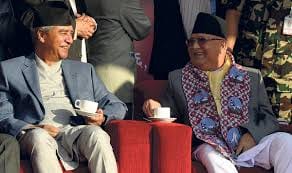
For many observers, the biggest weakness of the Congress–UML alliance is its lack of a coherent, long-term reform vision. Beyond the initial agreement, there has been no updated roadmap, no transparency on how power will rotate, and no clear communication with the public. The idea that Prime Minister Oli would hand over power to Nepali Congress leader Sher Bahadur Deuba remains a vague commitment rather than a scheduled transition.
The ruling parties themselves acknowledge this drift. Nepali Congress leaders have openly criticized the government’s underwhelming performance. Many believe that the coalition is becoming a caretaker arrangement focused on sharing posts rather than solving pressing national problems.
Learning from the Past: What Remains True
To be fair, the problems that haunt this government did not begin with this alliance. The culture of corruption, the weak delivery capacity of the bureaucracy, and the politicization of oversight bodies have deep roots in Nepal’s post-1990 democratic experiment. Previous governments, whether led by Congress, UML, or the Maoists, have all promised clean governance and failed to deliver fully. Some positive institutional legacies — like local government empowerment, community-based health services, and social protection schemes — survive precisely because they have popular roots and broad support, not because they depend on whichever leader is in Baluwatar.
A Balanced Ledger: Pros and Cons After One Year
| Strengths | Shortcomings |
|---|---|
| Some improvements in passport issuance, citizenship, and local registration services. | Constitutional amendment stuck; no timeline for genuine progress. |
| Expanded free health programs, HPV vaccination, and decentralized complex treatments. | Corruption scandals at the Cabinet level, with no action taken. |
| Macro stability amid global crises; better bank liquidity. | Low capital expenditure, stagnant investment, rising debt. |
| Continuity of local-level infrastructure and federal service delivery. | Education reform stalled, with major bills in limbo. |
| Small digital governance steps reducing petty corruption. | Oversight institutions weakened, accountability undermined. |
The Road Ahead: What Needs to Change?
One year on, the Congress–UML alliance must recognize that surviving in power is not the same as governing meaningfully. Citizens increasingly expect more than slogans and symbolic committees. Constitutional amendments must be pursued through broad, inclusive dialogue — not just elite negotiations in party offices. Corruption scandals must be met with real accountability, not protective silence.
Most importantly, economic policy needs to go beyond managing liquidity and macro indicators. Without local job creation, industrial revival, and strategic investment in green and resilient sectors, Nepal’s youth will continue to vote with their feet — by leaving.
Nepal’s citizens have shown remarkable patience and resilience through decades of instability. But their patience is not infinite. Whether this coalition leaves behind an enduring legacy — or merely passes the baton to another caretaker government — depends on whether it can translate promises into real, measurable change on the ground. That will require courage, vision, and integrity that, so far, have been in far too short supply.