
Resistance Builds Within the US Against Trump’s Drive to War With Venezuela
As Washington’s confrontation with Venezuela intensifies, a broad resistance is steadily growing inside the United States. While President Donald Trump continues issuing threats against the Bolivarian Republic, voices from Congress to neighborhood streets are rising to halt what many fear could become another devastating conflict.
Rumors of back-channel communication between Trump and Venezuelan President Nicolás Maduro have done little to calm tensions. Instead, Trump has escalated his rhetoric with declarations that defy international law—most notably his unilateral announcement on November 29 that Venezuelan airspace was “closed.” Flights continued normally, underscoring the symbolic yet reckless nature of his statements.
Meanwhile, officials within the Trump administration—Secretary of State Marco Rubio and Defense Secretary Pete Hegseth among them—have repeatedly warned that military strikes could begin “any moment.” So far, the only active hostilities have been US air assaults on vessels in the Caribbean. These strikes have already killed at least 83 people. Washington asserts the targeted boats were transporting drugs, though it has offered no verifiable evidence.
Still, the military buildup has continued at an alarming pace. The deployment now includes the aircraft carrier USS Gerald R. Ford, F-35 fighter jets, eight warships, and around 15,000 American troops, with coordinated operations in Puerto Rico, Trinidad and Tobago, and the Dominican Republic. The scale of the mobilization signals an unmistakable preparation for deeper confrontation.
Yet public opinion in the United States tells a different story. A new CBS News/YouGov poll shows that 70% of Americans oppose a US military intervention in Venezuela, marking a significant shift from the war-hungry climate that enabled previous invasions. Only a small fraction of respondents believe Venezuela is a serious threat to US national security. The American people appear unwilling to be swept into another catastrophe abroad.
Growing Pushback in Congress
Inside Congress, pressure is mounting as well. Lawmakers on key committees have launched oversight investigations into Defense Secretary Pete Hegseth, particularly over the deadly boat strikes in the Caribbean. Reports indicate that the order at the time was to “kill everybody” on board—an instruction that, if confirmed, would amount to a grave violation of international law.
Sen. Roger Wicker, the Republican chair of the Senate Armed Services Committee, acknowledged the seriousness of the allegations, pledging “special oversight” into the matter. The scrutiny intensified after revelations that a second strike—known as a “double tap”—was executed on a burning vessel as survivors clung to its edges. Hegseth has attempted to deflect responsibility, blaming Admiral Mitch Bradley for the decision.
Adding to his troubles, the Pentagon’s inspector general recently found that Hegseth disregarded departmental protocols by sharing classified strike information over a messaging app, potentially endangering US forces.
In response to the growing unease, lawmakers from both major parties have attempted to reinforce the War Powers Act in hopes of limiting Trump’s ability to unilaterally launch attacks. Although progress remains limited, it marks a rare moment of bipartisan resistance to executive militarism.
A Rising Movement in the Streets
Beyond the halls of Congress, ordinary Americans are also pushing back. The same CBS/YouGov poll revealed that 75% of respondents want the government to present evidence that the targeted boats were carrying drugs—another sign that public trust in official war narratives is fraying.
Brian Becker, National Director of the ANSWER Coalition, noted that the administration’s aggressive posture is deeply out of step with the mood of the country. For many, Trump’s threats are seen not as a matter of national defense but as an attempt to dominate a nation with vast natural resources.
Following Trump’s claim that land strikes were imminent, a coalition of grassroots groups—including The Peoples Forum, the Party for Socialism and Liberation, the Palestinian Youth Movement, and others—announced a national day of action on December 6. Demonstrations are planned across more than 50 cities under the slogan: “No War on Venezuela – Stop the War Before It Starts.”
Organizers argue that the Caribbean strikes already violate international norms and that any escalation into Venezuelan territory would constitute an outright act of war. They warn that such aggression could quickly spiral into a full-scale invasion, inflicting enormous suffering on civilians and destabilizing the region.
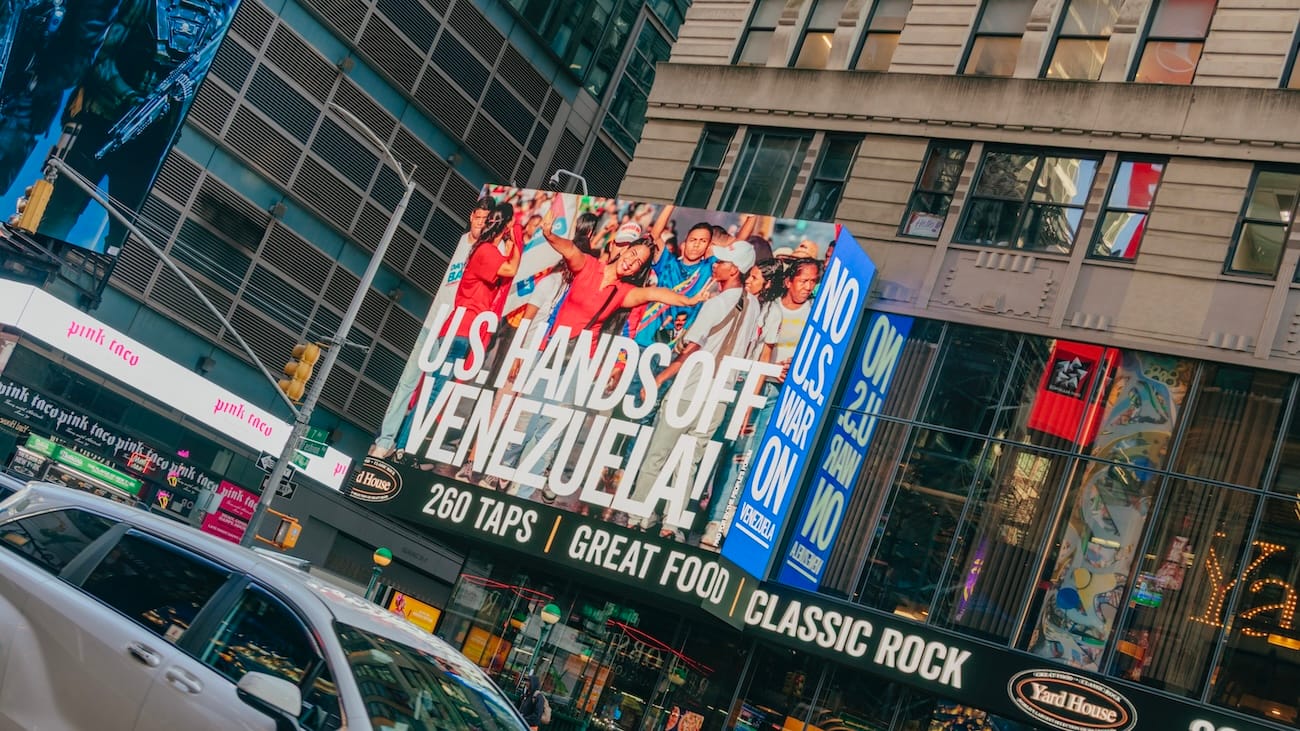
A Nation Tired of Endless War
The United States is still carrying the heavy legacy of prolonged wars in Iraq and Afghanistan. After two decades of loss, trauma, and disillusionment, the appetite for another foreign intervention is remarkably low. The rising resistance—inside Congress, in public opinion, and across the grassroots landscape—reflects a society that no longer accepts war as an inevitable or acceptable tool of policy.
As the world watches Washington’s next steps, one thing has become increasingly clear: millions of people across the United States are refusing to be drawn into yet another avoidable disaster. Their mobilization signals a growing understanding that the cost of war is far too high—both for the people of Venezuela and for the United States itself.