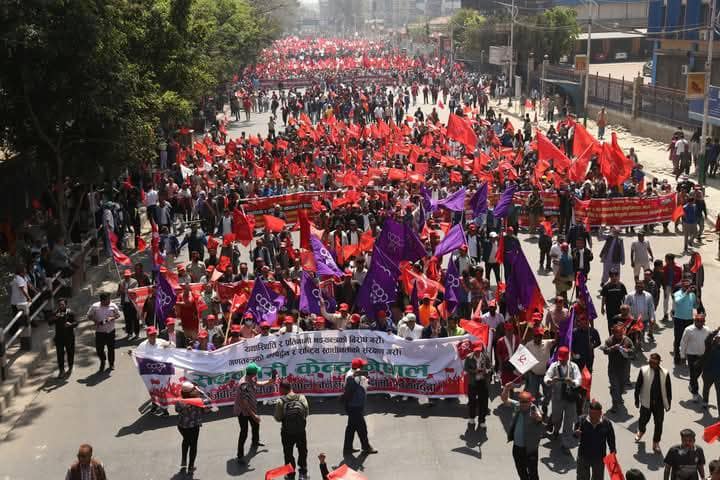
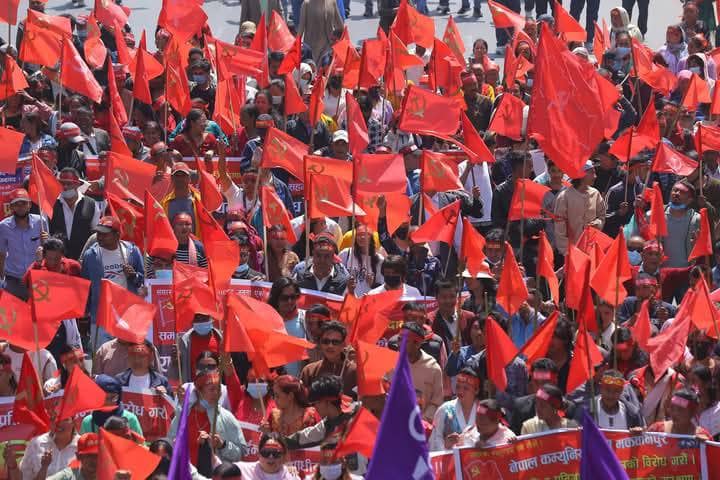
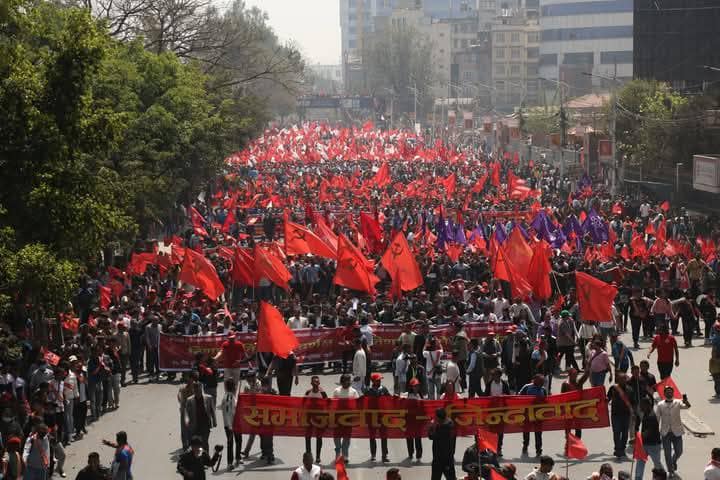
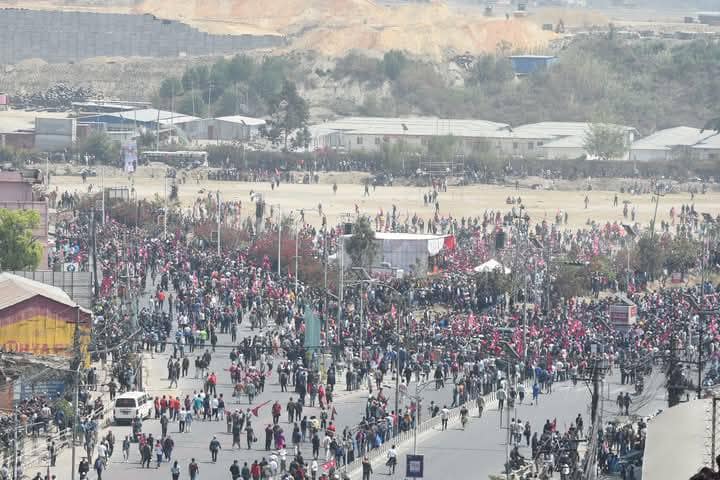
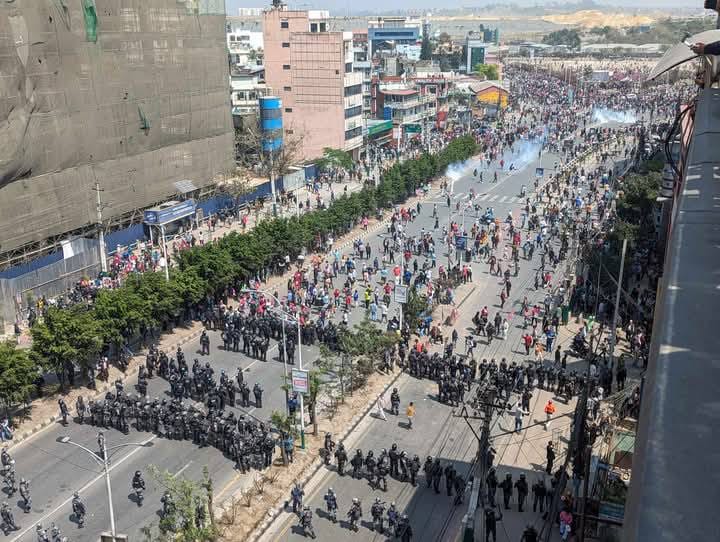
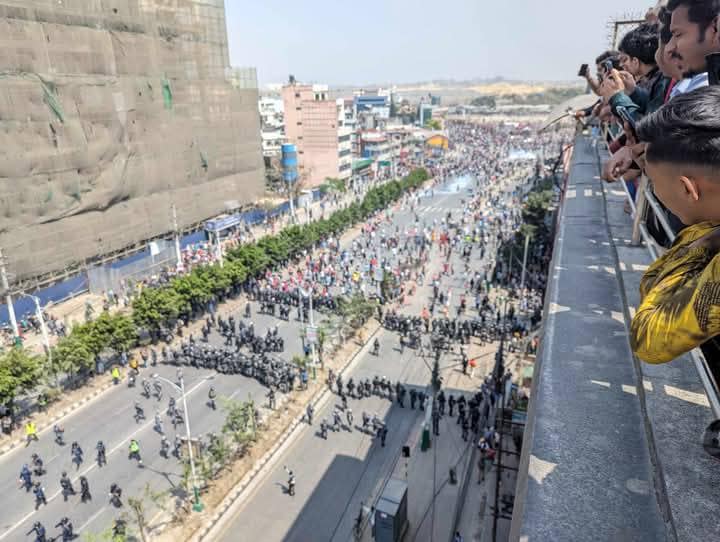
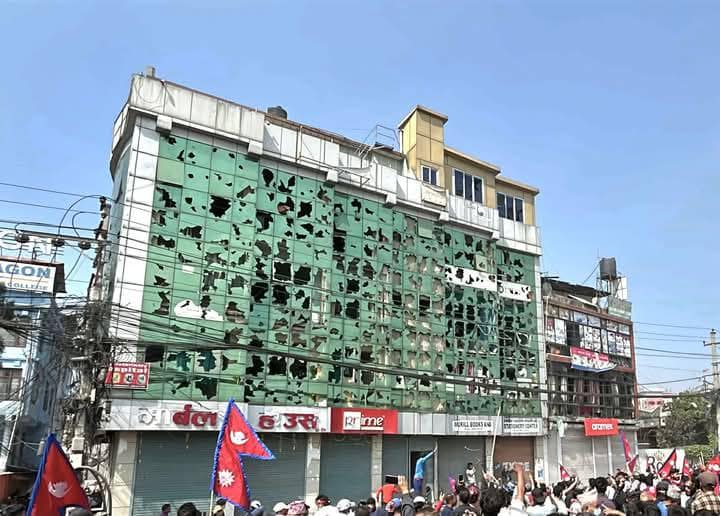
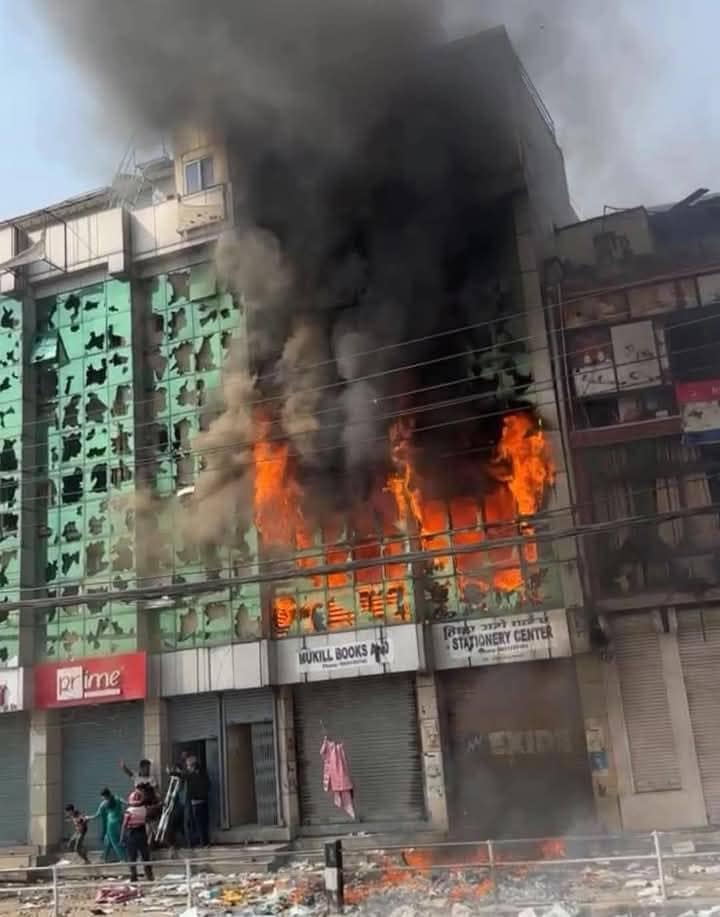
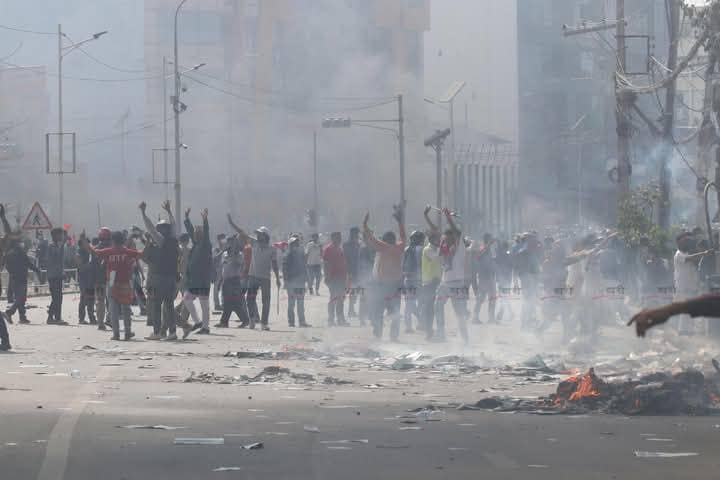
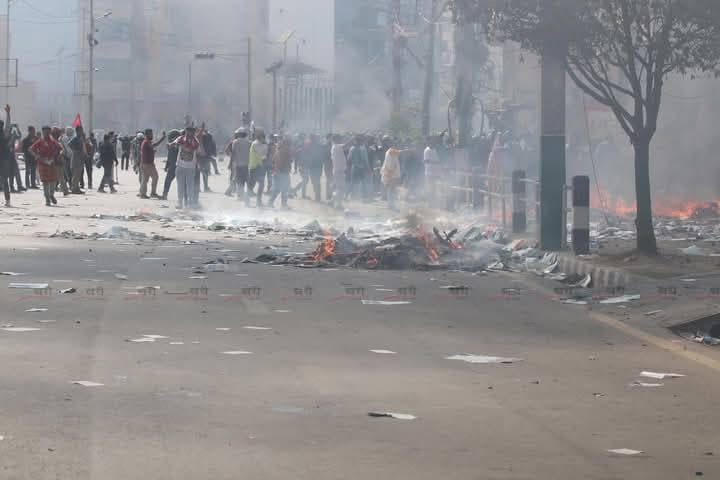
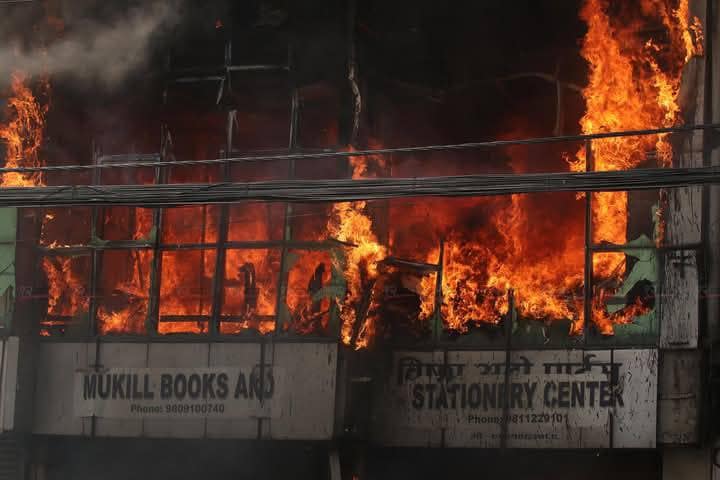
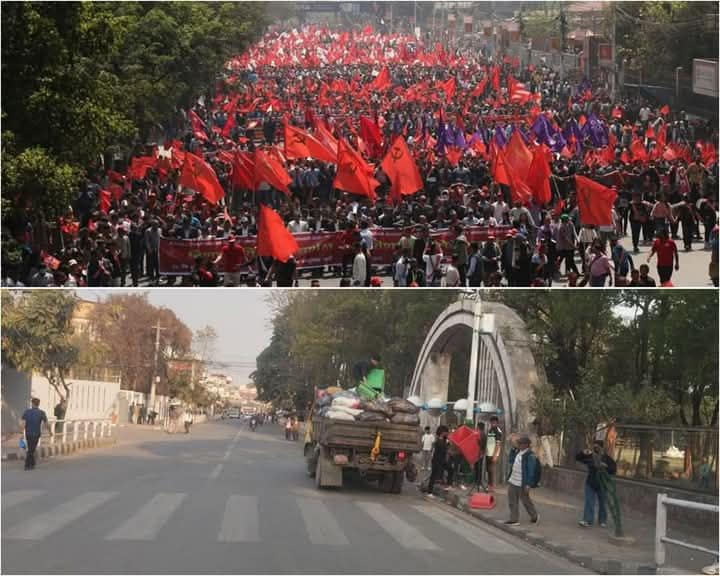
On March 28, 2025, the pro-republic and pro-monarch organized rival protest in Capital of Nepal, Kathmandu. Both organized this demonstration to show the public support and strength for and against the Republic. According to the Ministry of Home Affairs, official statistics shows, there were around 4,000 people in pro-monarch demonstration whereas there were around 35,000 people in the pro-republican protest. This is the second protest of pro-monarch who welcomed the king with a big rally while returning back to Kathmandu from another city Pokhara. Pro-monarchy forces are active for the last few weeks especially after a provocative statement of former king on February 19 on the occasion of Democracy Day. Pro-republican forces, the alliance of four opposition left parties, Socialist Front actually organized this massive protest to counterresponse what they call reactionary and regressive forces. While the republican protest was peaceful the monarchist turned violent vandalizing public and private property irrationally and attacking security personnel. Two people lost their lives, and a few others were injured. There was a clear attempt by monarchists to create chaos and take advantage of the crisis. They set fire to public industries, department stores, and private buildings. They also vandalized the central office of the Communist Party of Nepal (Unified Socialist) and burned important documents and furniture. They intended to incite further violence, but the police responded with patience and restraint.
Few people say that weather and politics in Nepal are unpredictable. This is true in the context of political instability and fragile politics in Nepal. Since Multiparty system was restored in Nepal in 1990, there has been 32 governments. Similarly, after 2008 when Nepal was declared Republic, Nepal has had 13 governments. This is the 14th in a row.
Majority will blame top leaders of Major Political parties who are not only heading parties but also led the government time and again. Deuba, Oli and Prachanda are major culprits who had become prime ministers many times; Deba sixth times, Oli fourth times and Prachanda three times. Similarly, other former Prime ministers are also heading a party and active in politics. These all leaders of above 70 years are the face people have seen for the last 30 years. But deep in the bottom, there are many other cause of the present crisis.
Like the unprecedented weather, unprecedented politics in Nepal can’t be summed up without the account of historical, dialectical and global perspectives. Geopolitical strategic location, rivalry of immediate neighbor China and India, US attempt to influence Nepal and use against China, own agenda and interest of EU has actually made Nepal a battlefield of their power struggle. Therefore, once a left coalition is formed, India in alliance with US and other rightist use their head-to-toe strength to crumble the government. Similarly, within the party also there are rifts, interest groups and factions which can be easily used to weaken the party and fail the government. Therefore, instability and interferences are two sides of the same coin.
This piece highlights here in brief, what is happening in Nepal and why ?
The country is in crisis. The political instability and interference have resulted in deep inequality, unemployment, sluggish economic growth, low level of industrialization, rapid migration and brain drain, poverty and food insecurity, high indebtedness and so on. In this list climate crisis and other disasters are adding to the impacts and suffering. More importantly, many forces are trying to take advantage of this crisis and fulfill their interest.
Every time the government changes, its only the game of the rule change. There’s nothing have changed for the country and people. That is why huge dissatisfaction among people, the frustration against the leaders, political parties and system. Not only Political and economic crisis. Larger crisis which is systemic and putting the system in crisis. The constitution of Federal Democratic Republic of Nepal 2015 is threatened. Federalism is criticized and questioned. There are voices against republicanism. New tendency of neo-fascism and populism.
In this crisis, the pro-mochary forces, the conservatives and reactionaries are trying to “Fish in troubled waters”. Everyone knows there are problems, even the political parties and their cadres know it. But those regressive forces are trying to blame political parties and republican system for the crisis. Unfortunately putting Restoration of Monarchy, Hindu State and End of Federalism as the solution. And many of us know, they are politically and economically supported by rights and conservatives advocating Hindutva.
Some of the key reasons on why this is happening can be listed as
- The failure of present government and past government to deliver and fulfill the aspirations of people. Especially, this government is the government of two third majority of two historically rival major two parties. That’s why the failure of this government is the failure of political parties and system.
- Increasing corruption, bad government and impunity. Few recent scams such as Gold Scam, Bhutanese Refugee Scams, Giri Bandhu Tea State Scam etc has shown the people the extent and amount of corruption going on in country for the last many years. That has created a narrative that no one is clear and transparent among top leaders because they were part of government this or that time. The lack of rule of law, bad government and anarchism of those in power has made people angry.
- Dissatisfaction and frustration of the people. The failure of government to delivery to people but protection of corruption and impunity has huge impacts on emotions and sentiments of general masses who are already impacted by social unrest, unemployment, foreign labor migration. The populist forces and regressive forces are creating a narratives that enough is enough, these senior political party leaders and established political parties are the culprit. That has given the space of monarchist or someone like Durga Prasai. Actually the anti-establishment reaction is growing for the last few years and rise of Mayor of Kathmandu City, Balen Shah; was also the result of growing dissatisfaction of people against the established political parties.
- Lack of Development agendas and weak leadership. They don’t have any development agendas. The vision for the country and people. Not bothered by the suffering of the people and challenges nation is facing. No interest in building nations, creating employment opportunities. They are interested in loot, power capture, nexus with corporations and compradors. Similarly, incapable Leadership and Accountability are also important causes. Most of the leaders who rule the country have proved to be incapable. Though they may be
- Weaking of the state and attack to the Left. Left in Nepal are penetrated heavily. Ideological degeneration and political revisionism have turned them not different from any bourgeoisie party. They have forgotten their class, their ideology and their agendas. That is why other forces took advantage of this weakness. Actually anti-communist forces are trying to defame left of Nepal to weaken the sovereignty and progress of country. Actually, Penetrated bureaucracy and corrupt judiciary and weak state mechanism won’t allow anyone to make a change easily. There will be isolation and ghettoization of the good by the network of crime and muscle rule.
Conclusion
Amid this crisis, pro-monarchy conservatives and reactionaries are trying to capitalize on frustration. While systemic failures are widely acknowledged, these groups scapegoat the republican system itself, advocating for restoring the monarchy, reinstating a Hindu state, and abolishing federalism. Many suspect ties to right-wing Hindutva groups backing such agendas. But in the context of lacking development agendas by major political parties, these forces taking advantage of crisis can’t be neglected. The 2015 Constitution of Nepal, which established a federal democratic republic, faces challenges from streets as well as political parties. Federalism is under scrutiny, republicanism is questioned, and neo-fascist and populist movements are rising. Genuine steps and response are needed from the government and other political parties.
Therefore, Nepal’s crisis is systemic, with instability and foreign interference perpetuating a cycle of failure. Without addressing corruption, delivering reform, and safeguarding democratic institutions, the nation risks further regression. The world watches as one of the youngest Republic Nepal navigates this precarious conjuncture.